

A missed leasing call can leave a prospect without a clear next step. An AI receptionist for property management can answer tenant and prospect calls, collect maintenance details, and route requests to staff. It keeps intake moving, while emergency judgments and lease exceptions remain with your team.
That balance matters. Property calls range from routine questions to urgent repairs, and a quick answer helps only if the request reaches the right person. The right tool can ease the front desk workload without taking over decisions that need staff judgment.
This guide explains what an AI receptionist can handle, how it can support leasing and maintenance intake, and which safeguards to consider. It compares common call-handling options and offers a practical way to assess them for your property team. You’ll see where automation can help capture opportunities and where a person should stay in control.
Key Takeaways
- Set consistent call scripts and keep fair-housing-sensitive conversations under human control.
- Use clear emergency routes, named escalation contacts, and a follow-up task when a transfer fails.
- Capture the details needed to move leasing leads and maintenance requests to the right next step.
- Compare call-handling options by their routing, software fit, and the decisions they leave to your team.
What Are the Risks of Using an AI Receptionist for Tenant Calls?
An AI receptionist can answer tenant and prospect calls around the clock, but clear routing and decision boundaries are essential. Define the call paths before routine questions, maintenance requests, or emergencies reach the system.
Fair Housing Risks and Call Scripts
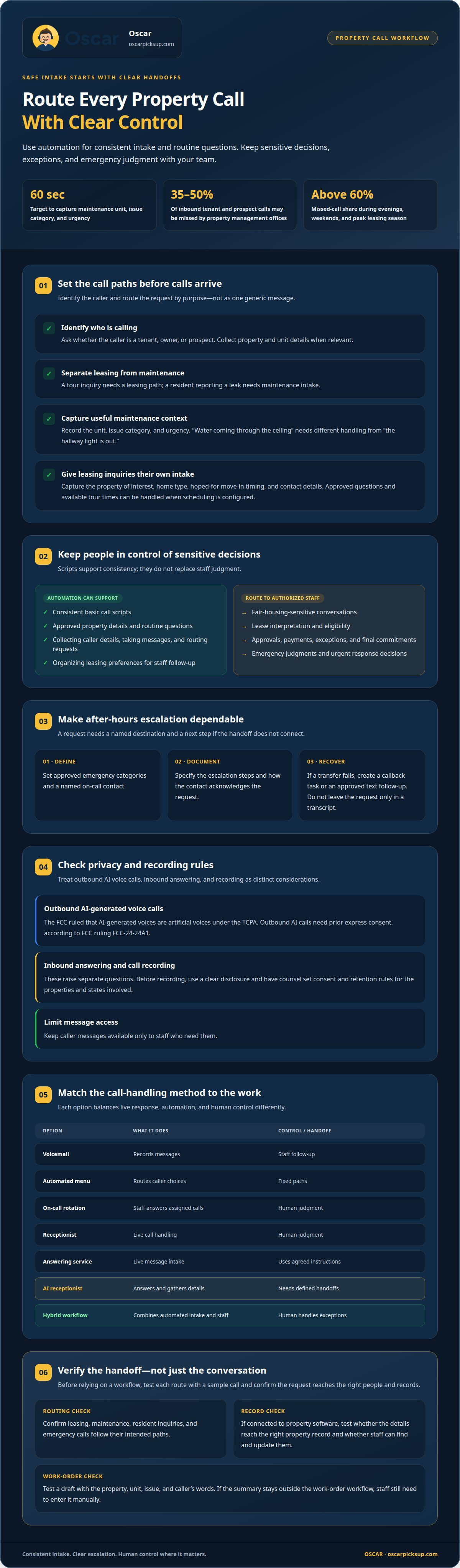
Consistent scripts keep leasing calls focused on the same basic steps: understand the caller’s needs, share approved property details, and offer a next step. They also help callers get consistent answers to routine questions. Scripts don’t replace human judgment. Route fair-housing-sensitive conversations, lease interpretation, approvals, payments, and exceptions to an authorized team member.
Call Patterns and Caller Identification
Different calls need different routes. A prospect asking about a tour needs a leasing path; a resident reporting a leak needs maintenance intake. Ask whether the caller is a tenant, owner, or prospect, and collect the property and unit details when relevant. Record the request and route it to the right team instead of treating every call as routine.
Privacy, Consent, and Call Recording
For outbound AI-generated voice calls, the FCC ruled that AI-generated voices are artificial voices under the TCPA, and outbound AI calls need prior express consent, according to the FCC’s FCC-24-24A1 ruling. Inbound answering and call recording raise separate questions. Before recording, use a clear disclosure and have counsel set the consent and retention rules for the properties and states involved. Keep access to caller messages limited to staff who need them.
After-hours coverage needs a clear escalation path. Route approved emergency categories to a named on-call contact, with documented steps for escalation and acknowledgment. If a transfer fails, create a callback task or an approved text follow-up. Don’t let the request disappear into a transcript.
| Option | Call answering | Escalation and control |
|---|---|---|
| Voicemail | Records messages | Staff follow-up |
| Automated menu | Routes caller choices | Fixed paths |
| On-call rotation | Staff answers assigned calls | Human judgment |
| Receptionist | Live call handling | Human judgment |
| Answering service | Live message intake | Uses agreed instructions |
| AI receptionist | Answers and gathers details | Needs defined handoffs |
| Hybrid workflow | Combines automated intake and staff | Human handles exceptions |
A human receptionist or answering service can respond live and handle nuance. An AI receptionist can answer routine calls and collect details, but it needs a human escalation path. Match each call type to the right method, then test every route with a sample call.
Can AI answer tenant maintenance calls?
Yes. An AI receptionist can answer inbound maintenance calls, gather the key details, and pass the request to staff. Capture the unit, issue category, and urgency within the first 60 seconds. For example, “water coming through the ceiling” needs different handling from “the hallway light is out.” Clear intake gives the maintenance team useful context before dispatch.
Leasing calls need a separate path. The system can ask which property interests the prospect, what type of home they need, and when they hope to move. It can answer approved questions, collect contact details, and offer available tour times when scheduling is configured. Staff can then follow up with the prospect’s preferences instead of starting with a blank message.
Qualification should organize inquiries, not make approval decisions. A caller’s move-in timing or preferred layout can guide the next conversation, while lease eligibility, exceptions, and final commitments stay with authorized staff. For tour bookings, route the selected property and time to the leasing team or connected calendar. This keeps the request tied to the right property instead of sending it to maintenance by default.
After-hours coverage helps capture leasing leads and resident requests when the office is closed. Property management offices miss roughly 35-50% of inbound tenant and prospect calls, with the missed-call share rising above 60% during evenings, weekends, and peak leasing season. An answering system can record the caller’s details and requested next step. Emergencies still need the property’s defined response process, while routine requests can enter the team’s normal queue.
Software integrations affect what happens after the call. A connected property management system can keep request details with the relevant property record; without a connection, staff need a clear message or task handoff. A configured call-intake workflow can help keep leasing, maintenance, and resident inquiries moving without mixing their next steps.
What Is an AI Assistant for Property Managers?
An AI receptionist handles defined tasks in a property team’s call workflow. For tenant calls, it can answer questions, gather details, take a message, and pass the request to staff. That record is useful only if it reaches the right property and team. If your portfolio has separate leasing and maintenance queues, set up clear routing for both.
Property management software integrations determine whether call details stay connected to tenant records. A one-way connection might send caller details into a system. A two-way integration can also retrieve approved information, such as property-specific details, and write new intake into the right record. The available fields and actions depend on the software connection.
Test work-order write-back separately. Have the system create a draft request with the property, unit, issue, and caller’s words. Then check whether staff can find and update it in the property management software. If a call summary stays outside the work-order workflow, someone still has to enter it manually.
Map the handoff before choosing an integration. First, identify the system that holds tenant and property records. Next, list what the assistant must read, such as property names, and write, such as maintenance intake. Finally, test duplicate callers, missing unit numbers, and requests requiring manager approval. These checks show where staff need to step in.
What are the best AI receptionist platforms for property managers in the US? The best fit is the option that supports your call workflow, the integrations your team needs, and human approval for sensitive decisions. Don’t judge a platform by its feature list alone.
Ask the vendor to demonstrate a tenant call from answer through record creation, routing, and follow-up. Check how failed transfers appear, whether staff can correct details, and what happens if a software connection is unavailable. For a smaller portfolio, reliable message delivery may matter more than write-back. For a busier team, reducing duplicate entry may be more important.
AI receptionist for property management
An AI receptionist for property management works best as the first step in a defined call workflow, not as the final decision-maker. It answers, gathers details, and routes requests. Your team sets approved answers and escalation paths, and decides which actions require staff judgment.
Build the workflow around three call groups: leasing, routine resident requests, and emergencies. For a leasing inquiry, capture the property and requested next step. For maintenance, gather the unit, issue, and urgency. Route emergency categories to the named on-call contact. Keep lease interpretation, approvals, and exceptions with authorized staff.
Triage should separate urgent from routine without treating every repair as an emergency. NAA 2023-2024 AppWork platform data identifies 6.67% of work orders as true emergencies. That figure underlines the value of collecting useful details before dispatch. A report of water entering a unit needs a different route from a request about a loose cabinet handle.
Call volume can help determine whether an AI receptionist, an answering service, voicemail, or a mix suits your operation. Voicemail records a message, but staff still need a clear follow-up task. A live answering service can take calls, while an AI system handles routine intake and applies set routing rules. In a hybrid setup, staff take over exceptions and sensitive conversations.
Check language handling before using a system with residents who prefer different languages. Find out how it captures names, addresses, and repair details when callers speak quickly or describe an issue in their own words. A misheard unit number can send a work order to the wrong place.
Choose the option that reliably answers your common calls and preserves human control over urgent or sensitive decisions. Set the call categories, escalation path, and fallback before expanding coverage. Set up your call coverage around the requests your team needs answered.
Oscar: Oscar AI receptionist
Oscar AI receptionist answers incoming business phone calls 24/7, so tenant and prospect calls have a clear first point of contact. It can answer questions, take messages, and book appointments. For a property team, that can help capture leasing inquiries and appointment requests while staff focus on work that needs their judgment.
Oscar suits teams that want software to answer routine calls instead of sending them to voicemail. It doesn’t replace staff decisions about emergencies, lease terms, approvals, or unusual requests. Set those boundaries in your call process and keep people responsible for sensitive cases.
For a steadier way to handle incoming business calls, contact Oscar to discuss Oscar AI receptionist.
Build a Call Process That Can Adapt
Your property team’s call needs can change as the portfolio, staffing, or resident expectations shift. Treat the call workflow as part of daily operations, not a set-and-forget tool. Review where callers get stuck, where staff need clearer context, and which answers need updating. Then adjust the process to match the work your team handles today.
A well-chosen AI receptionist for property management should fit your current operation and leave room to refine how calls move through it. Keep responsibility clear when a request needs a person, and make the next step simple for callers. That helps the system support your team without blurring who makes decisions.
Oscar offers Oscar AI receptionist for businesses that want incoming calls answered by software. Contact Oscar about your call-handling needs. A practical call process is within reach.
Frequently Asked Questions
Can an AI Receptionist Handle Maintenance Emergencies After Hours?
Yes. It can collect emergency details and start a defined escalation workflow. For example, a caller reporting a burst pipe needs a route to the on-call contact, not just a saved voicemail. Set which categories trigger escalation, who receives them, and what happens if nobody acknowledges the alert. Keep emergency judgments and response decisions with your property team.
Can an AI Receptionist Handle Both Voice Calls and Text Messages?
Some systems support both channels, but voice answering does not automatically include text messaging. Each channel needs its own setup, response rules, and handoff path. Oscar answers incoming business phone calls, responds to questions, takes messages, and books appointments. Don’t assume a phone-answering system also replies to texts; treat SMS as a separate capability in your workflow.
How Does an AI Receptionist Integrate with AppFolio and Buildium?
Integration with AppFolio or Buildium depends on a supported connection. A useful setup maps caller details to the right property and record, then defines what staff can edit. Test a call with a missing unit number and one from an existing resident. These examples show whether the handoff creates clean records or leaves staff to sort out mismatched details.
Is an AI receptionist a fair-housing risk?
An AI receptionist can create risk if callers receive inconsistent leasing answers or the system handles sensitive decisions on its own. Use approved scripts for routine questions, such as how to request a tour, and route accommodation requests or eligibility questions to trained staff. Control script changes so a property update doesn’t leave one caller with outdated information and another with new terms.
What Does an AI Receptionist Do for Property Management Companies?
An AI receptionist answers business calls, responds to questions, takes messages, and can book appointments. A prospect might call to ask about a viewing, while a resident wants to leave a message for the office. The system handles the phone interaction; property staff remain responsible for decisions about leases, approvals, and unusual requests. That division defines its role.
Can AI Receptionists Integrate with Property Management Software and Leasing CRMs?
AI receptionists can connect with property software or leasing CRMs when a supported integration is available. A property management system holds resident and unit details; a leasing CRM tracks prospective renters and follow-up. Decide which system owns each record, then map call details to the right destination. Without that distinction, a prospect’s inquiry could land in a resident service queue.


