

An AI receptionist for an aircon company can answer incoming calls, take messages, and book appointments through a defined call flow. It can capture why a customer is calling and the details your business needs to respond. Spanish conversations and customer follow-up depend on the system’s language and messaging features.
That matters when you’re on a job and can’t pick up the phone. A caller still needs a clear next step, not a long wait or a dead end. This guide explains how AI booking works for HVAC calls, what to expect with Spanish and follow-up, and where automated answering has limits. You’ll also see what to consider before putting it in front of customers, so you can decide whether it fits the way your business handles service requests.
Key Takeaways
- Set clear rules for what an automated receptionist can book, what details it should collect, and when a call needs a person’s attention.
- Test how it handles urgent air-conditioning problems, caller questions, and requests it can’t resolve.
- Compare automated answering with a human service by looking at availability, caller experience, message handling, and follow-up needs.
- Review Spanish-language and customer-message workflows before choosing a setup, so callers get a clear next step.
What are the benefits and drawbacks of using an AI receptionist for an HVAC company?
An AI receptionist can answer routine calls while technicians work onsite. It can collect a caller’s name, address, contact details, and reason for calling. With clear booking rules, it can schedule a service visit rather than leave the customer waiting. The request is captured, but a booked appointment does not mean a technician has diagnosed the problem.
Consistent intake helps the office sort requests. A caller reporting warm air needs a different next step from someone asking about seasonal maintenance. The system can ask what the equipment is doing, where the customer is located, and how to reach them, then pass the answers along as a message. Clear questions can reduce back-and-forth, provided the caller’s answers are understood correctly.
Urgency needs careful handling. Test the call flow with indoor temperatures of 78, 85, 88, and 92 degrees. Check whether each answer leads to the right next step under the company’s rules. Then test real-life context. A caller may say an 82-year-old mother is in a home without working air conditioning. The system should capture that detail, not flatten it into a generic cooling complaint.
Use specific scenarios to find gaps before calls reach customers:
- A homeowner says the system is 19 years old and asks about replacement. The receptionist should capture the request without promising a diagnosis or replacement decision.
- A caller reports that the air conditioner stopped working. The system should collect the location, symptoms, and callback details before routing or recording the request.
- A Spanish-speaking customer asks for an appointment. The caller needs clear prompts and a usable next step in Spanish, not a conversation that breaks down midway.
Automated answering has limits. A caller may need a technician’s judgment, a firm arrival time, or advice about an unfamiliar sound. An automated system cannot inspect equipment or assess conditions onsite. Set an escalation path for questions outside its approved answers. For Spanish calls, test service terms, addresses, names, and phone numbers. A fluent greeting alone does not show that the full intake works.
Honest disclosure also matters. HVAC callers may hang up within 20 seconds when an AI receptionist dodges a direct question about being human. Give it a plain answer if asked. Then let the caller choose whether to continue. A direct response protects trust better than a script that tries to sound human without answering.
Call recognition brings another risk. A street name, unit number, or equipment detail can be misheard and sent to the wrong place. Test caller pauses of 600 to 1,200 milliseconds inside addresses and phone numbers. Include background noise, corrections, and repeated details. A useful release check is zero failures across 150 runs per mistake, which estimates the failure rate is likely under 2%. Fix errors before widening the call flow.
Assess the whole handoff, not just the greeting. Check whether messages capture the customer’s request, bookings follow scheduling rules, and follow-up reaches the right person. Note missed details and caller drop-offs in different scenarios. An AI receptionist for an aircon company is most useful for repeatable intake and booking. Leave complex diagnosis and judgment to qualified staff. This gives callers a clear route without expecting software to do fieldwork.
How do AI receptionists compare with human answering services for HVAC businesses?
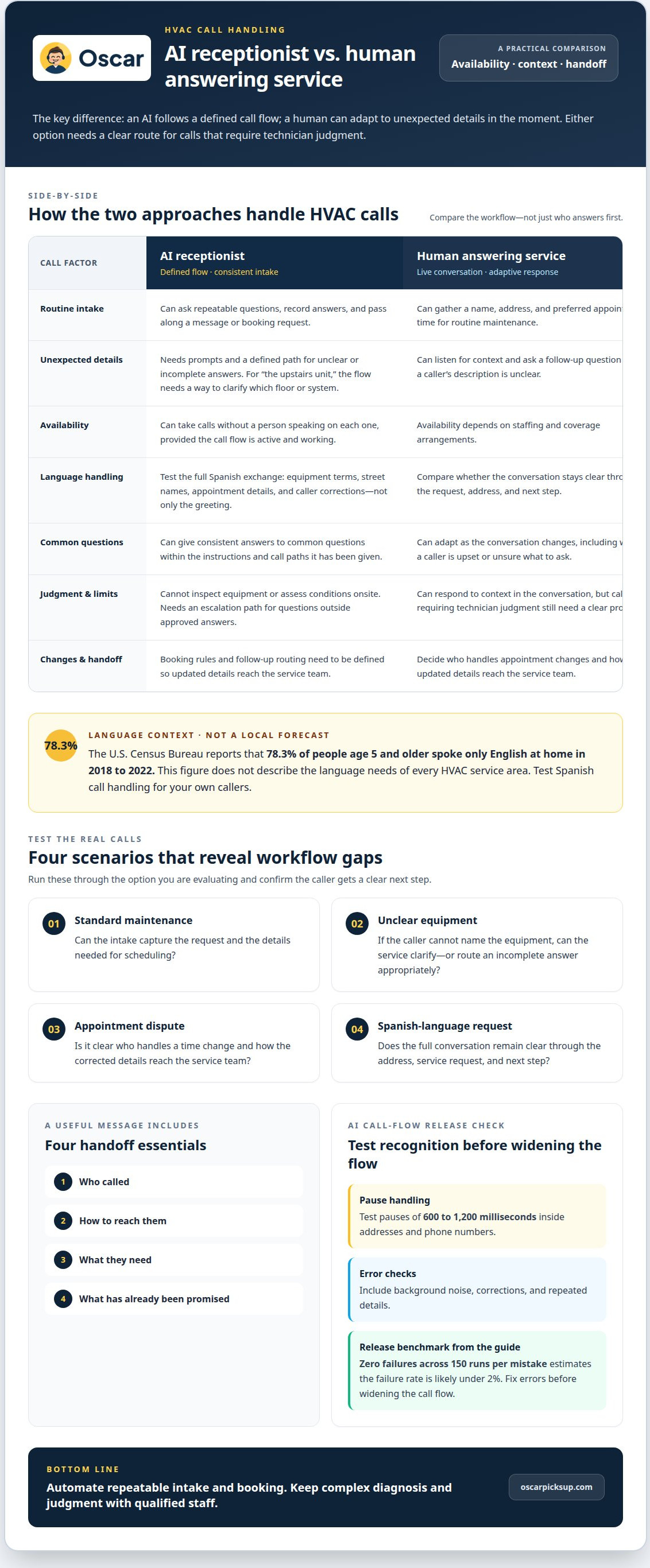
The main difference is how each handles a caller’s words. An AI receptionist follows a defined call flow, while a human answering service can respond to unexpected details in the moment. Either may gather a name, address, and preferred appointment time for routine maintenance. A caller describing a confusing noise may need follow-up beyond a standard intake script.
AI can suit calls with repeatable steps: asking the same intake questions, recording answers, and passing along a message or booking request. A human agent can listen for context and clarify unclear answers. If a homeowner says “the upstairs unit,” for example, a person might ask which floor or system they mean. An automated flow needs a prompt for that distinction.
Availability also shapes the comparison. A human answering service depends on its staffing and coverage arrangements. Automated answering can take calls without a person speaking on each one, as long as the call flow is active and working. That can matter when a technician is driving, on a roof, or speaking with a customer in person. Either option needs a clear process for calls that require a technician’s judgment.
Language is another practical test. The U.S. Census Bureau reports that 78.3% of people age 5 and older spoke only English at home in 2018 to 2022. That figure doesn’t describe the language needs of every HVAC service area. For a Spanish-language call, compare how each option handles the full exchange, not just the greeting. Test equipment terms, street names, appointment details, and a caller who changes their answer.
Human answering can help when callers are upset or unsure what to ask, because a person can adapt as the conversation changes. An AI system can give consistent answers to common questions, within the instructions and call paths it has been given. If a caller asks whether a technician can diagnose a fault by phone, the response should follow the business’s rules rather than guess.
Consider these call examples before choosing a setup:
- A customer wants a standard maintenance visit. A set intake process can capture the request and the details needed for scheduling.
- A caller reports a problem but can’t name the equipment. A human may ask follow-up questions; an automated flow needs a clear path for incomplete answers.
- A customer disputes an appointment time. Decide who handles changes and how the updated details reach the service team.
- A caller asks for help in Spanish. Test whether the conversation stays clear through the address, request, and next step.
Compare the handoff, too. A useful message states who called, how to reach them, what they need, and what has already been promised. Decide how that information reaches the office and who acts on it. Run the same sample calls through each option, noting missed details, unclear replies, and callers left without a next step.
For an HVAC business, the choice needn’t be all or nothing. Routine requests may suit automation, while unusual complaints or sensitive conversations may need a person. Set the boundary first. If you’re weighing automated call handling for your service calls, review the call-handling approach as a possible fit.
Oscar: Oscar AI receptionist
Oscar is an AI receptionist that answers incoming business calls, takes messages, and books appointments. For an HVAC business, callers can leave service requests while you work onsite, and appointment requests can be handled through the call flow. Oscar also answers caller questions, helping routine enquiries move forward without pulling you away from the job.
Use Oscar when calls interrupt fieldwork or you need incoming messages captured. Oscar is software, not a technician: it handles phone conversations, not equipment diagnosis or repairs. Shape the call flow around the information your office needs, such as the caller’s contact details and reason for calling.
To handle incoming calls more consistently, contact Oscar about its AI receptionist.
Set Up a Better Call Handoff
Start by defining what callers should experience from the first ring to the final handoff. Decide which requests can follow a set path, what information the office needs, and where calls should go when they require human judgment. These choices give an AI receptionist for aircon businesses a clear role without replacing field expertise.
Oscar offers an AI receptionist for businesses that want incoming calls answered, messages taken, and appointments booked through an automated system. Consider whether this approach fits your daily work and customer flow.
Contact Oscar to discuss your needs. A practical call process starts with a clear plan, and you can take that step at your pace.
Frequently Asked Questions
Can an AI receptionist book HVAC jobs?
Yes, an AI receptionist can schedule HVAC appointments when its call flow includes booking. It can collect the caller’s preferred time, service address, and reason for the visit. For example, a homeowner requesting seasonal maintenance can provide details for a booking without describing a breakdown. The business sets the appointment rules, including which requests can be booked and which need staff review.
Can an AI receptionist quote HVAC prices?
An AI receptionist should quote only prices the business has approved and can explain clearly. Routine service may have different terms from a repair that depends on equipment condition, parts, or diagnosis. A caller seeking a fixed repair quote may need an inspection first. The receptionist can record the request and explain the next step instead of guessing.
What happens when an AI receptionist transfers an HVAC call?
If the call flow supports transfers, it can route callers to a chosen person or number. The receiving team should know why the caller is calling, such as to change an appointment. If no one answers, the flow can offer another option, such as taking a message. Set these steps in advance so callers know what to do next.
What is an AI receptionist for an air conditioning (HVAC) business?
An AI receptionist is voice software that answers incoming business calls and handles defined tasks through conversation. For an HVAC company, it may answer common questions, record a request, or book an appointment. It cannot inspect an air conditioner or decide what repair it needs. Think of it as a phone-based intake point that follows business instructions and passes customer details along.
How does an AI receptionist handle HVAC calls, scheduling, and service requests?
It follows a call flow: greet the caller, identify the request, collect relevant details, and provide an appropriate next step. A customer calling to reschedule needs a different path from someone reporting a new problem. The business defines the questions and booking rules. Clear prompts help capture details such as an apartment number or preferred callback time.
Which AI receptionist services are best for HVAC companies in the United States?
The best fit depends on the tasks you want handled. Compare whether a service can answer incoming calls, respond to common questions, take messages, and book appointments in line with your process. Oscar’s AI receptionist is an automated software option for those tasks. If your business needs a person to manage nuanced conversations, an AI receptionist alone may not meet that need.


