
An AI receptionist for cleaning businesses can answer incoming calls, respond to common questions, collect job details, take messages, and book appointments. It keeps calls moving while you’re on a job, so a new inquiry doesn’t have to wait until you finish the work in front of you. The key is setting clear booking rules and deciding what information it should collect first.
That matters when callers want a quote, ask about recurring service, or need to schedule a clean. A useful call should capture the caller’s name and callback details, the type of cleaning, property information, and preferred timing. You set the services and booking rules; the receptionist handles the first conversation and passes along the details. This guide explains how to structure those calls, what job information to collect, and which features to look for. It also covers when automated booking makes sense and when a message or follow-up is the better next step. The goal is to keep the phone covered without pulling you away from the work.
Key Takeaways
- Set call coverage so inquiries can be answered while crews are working or the office is closed.
- Capture the cleaning type, property details, and preferred timing to make each inquiry easier to assess.
- Choose features that match your booking process, including answering questions, taking messages, and scheduling appointments.
- Learn when an automated receptionist can handle a booking and when a message is the better next step.
What is the best AI answering service for cleaning companies?
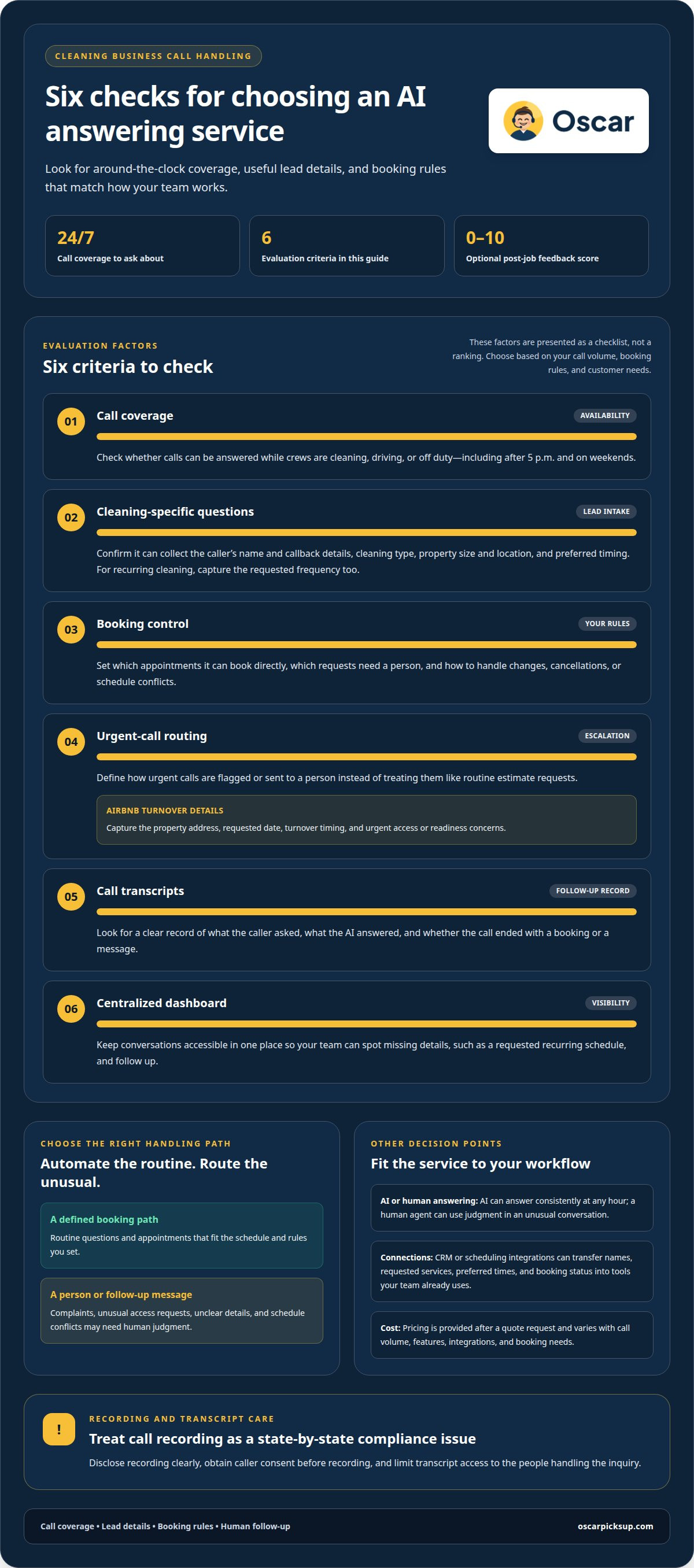
The best fit answers calls around the clock and qualifies each lead before booking. For a residential cleaning team, 24/7 coverage means a caller can reach an answering service while crews are cleaning, driving, or off duty. Ask whether the ai voice can explain service options, capture job details, and book within the schedule you set. A system that only takes a message may leave more follow-up work for you.
Start with six criteria: call coverage, cleaning-specific questions, booking control, urgent-call routing, transcripts, and a centralized dashboard. Intake should capture the caller’s name, callback details, service type, property size and location, and preferred timing. For recurring cleaning, record the requested frequency too. These details help your team assess whether a request fits before preparing a quote or confirming work.
For Airbnb turnover scheduling, a caller may need a clean between guest stays. The AI should capture the property address, requested date, turnover timing, and any urgent access or readiness concerns. Set rules for what it can book directly and what it should send to a person. Route or flag urgent calls according to your instructions, rather than treating them like routine estimate requests.
Call transcripts and a centralized dashboard can make follow-up easier. Look for a clear record of what each caller asked, what the AI answered, and whether the call ended with a booking or message. When the conversation is accessible in one place, it’s easier to spot a missed detail, such as a requested recurring schedule.
AI and human answering services handle calls differently. AI can answer consistently at any hour, while a human agent can use judgment in an unusual conversation. Choose based on your call volume, booking rules, and how often callers need personal handling.
US call-recording rules can vary by state. Treat recording as a state-by-state compliance issue: disclose it clearly, obtain caller consent before recording, and limit transcript access to people handling the inquiry.
Why cleaning businesses miss calls and lose jobs
Cleaning calls often arrive while the crew is already on a job. A lead may call after 5 p.m. or on a weekend, when no one is near the phone. Each missed caller may book another cleaner before your team can return the call. An answering service keeps the inquiry moving instead of leaving it unanswered.
Follow-up matters for missed calls and web requests. Capture the caller’s name and callback details, requested service, and preferred timing. Add web leads to the same follow-up queue. Then assign a clear next step: return the call, prepare a quote, or confirm a booking. A brief confirmation helps prevent confusion about what happens next.
Several callers may reach you at once during busy periods. An AI receptionist can capture their requests while your team finishes a clean, instead of leaving every caller in one phone queue. Keep booking rules clear, especially when two callers request the same available time.
Move-in and move-out requests need focused intake. Ask about the property, requested service, timing, and any specific areas needing attention. For example, someone moving out may need a full-property clean before handing over the keys. Capture the details first, and route unusual requests for review rather than treating every job as standard.
AI has limits. It may misunderstand unclear details or lack the judgment needed for unusual requests, complaints, or schedule conflicts. Set an escalation path: collect a message and send it to the person who handles complex calls. This keeps the caller’s request visible without implying that every case can be resolved automatically.
Set a defined follow-up route for calls and web inquiries, then review the captured details before confirming work. A clear automated call-handling process can help keep incoming requests organized.
AI receptionist features for cleaning businesses
Useful features start with clear intake. An AI phone assistant should capture the caller’s name and contact details, cleaning type, property information, and preferred appointment time. It can answer routine questions about service options, collect details for quotes, and take messages when a request needs review. Set coverage rules for business hours and calls that come in while crews are working.
Booking controls matter. Define which appointments the system can schedule, which requests need a person, and how urgent calls should be routed. For example, a caller asking to change a weekly cleaning can follow a set booking path. A complaint or unusual access request can instead become a message for your team. Don’t rely on voicemail as the only fallback when a caller needs a clear next step.
After a completed job, a feedback workflow can ask the customer for a score from 0 to 10. That gives your team a simple signal to review, while a low score can prompt personal follow-up. Keep customer messages and call records organized so staff can see what was requested and what response is due.
AI receptionist software costs vary and are provided after a quote request. Factors include call volume, required features, CRM or scheduling connections, and booking needs.
CRM and scheduling connections should transfer caller details into the tools your team already uses. A dependable handoff means names, requested services, preferred times, and booking status don’t need to be retyped. Confirm how the connection handles changes, cancellations, and requests that need staff review.
Set up the service by defining cleaning options, common answers, booking rules, and escalation paths. Then test sample calls for a recurring appointment, a quote request, and an urgent message. Adjust any prompt that misses a detail. Start with a focused workflow, then add more call types as your team learns what callers need.
What is an AI receptionist for a cleaning business?
An AI receptionist is software that answers incoming business calls and speaks with callers. For a cleaning company, it can explain service options, gather job details, take messages, and book appointments. It handles the first phone conversation, not the cleaning work. For example, a caller can ask about recurring home cleaning and share a preferred schedule.
The call follows a set path. The system greets the caller, listens to the request, and asks for useful details, such as the cleaning type and property address. It can answer routine questions using the information provided to it. If the caller needs a quote, it can collect details for follow-up instead of guessing a price.
It also works differently from a phone menu. Callers can describe what they need in their own words, such as moving an appointment or requesting a move-out clean. The receptionist can collect the request and pass it along. Your team sets the services, answers, and booking rules the system follows.
Call handling can continue while the owner is cleaning or driving between jobs. Oscar’s service information describes its AI receptionist as answering incoming business calls 24/7. That means callers can reach an automated assistant beyond staffed office hours. It does not make the system a human receptionist; it uses software to answer and manage calls.
This setup fits businesses that want routine calls answered, details captured, and appointments booked without staff answering every call. It may not replace a person for delicate complaints or unusual requests, so clear handoff rules matter. To see how automated call answering can handle cleaning inquiries, explore the service’s call-handling approach.
Oscar: Oscar AI receptionist
Oscar is an AI receptionist that answers incoming business calls 24/7. For a cleaning business, it can answer caller questions, take messages, and book appointments, so inquiries have a clear first step while you focus on scheduled work. It works as software, not as a human receptionist or phone service.
Use Oscar when you need calls answered consistently without stopping work to handle every routine inquiry. Callers can explain what they need, get answers, or leave a message for follow-up. Appointment booking can also help turn an inquiry into a scheduled job.
For a steadier way to handle incoming cleaning inquiries, contact Oscar to discuss its AI receptionist.
Set Up Call Handling Around the Work Ahead
Before choosing an AI receptionist for cleaning businesses, decide what a successful call outcome looks like for your team. Some callers need a booking; others need a clear message passed to someone who can handle a special request. Match each call path to the way your business accepts and follows up on work.
Start with the calls that interrupt your day most. Set the information each call needs, the answers callers can receive, and the point where a person should step in. Then test the process: does the caller leave with a booking, an answer, or a clear next step?
Oscar offers Oscar AI receptionist for businesses that want calls answered, messages taken, and appointments booked by software. A conversation with Oscar can help you consider how that approach fits your cleaning operation. Contact Oscar to discuss your call-handling needs. A well-planned first step can make phone work easier to manage.
Frequently Asked Questions
Can an AI receptionist for cleaners really book jobs on its own?
Yes, it can book jobs when the business has set clear scheduling rules. For example, it can offer an open appointment for a standard recurring clean, then record the caller’s details and booking choice. Keep exceptions, such as unusual property needs or schedule conflicts, on a separate path for staff review. The system can handle routine bookings while your team retains control over special cases.
What cleaning businesses should look for in an AI receptionist?
Look for a service that handles the calls your business actually receives. A residential cleaner may need intake for recurring visits, while a turnover team may need date-specific requests. Check whether the system can answer common questions, collect the details your team uses, and pass unusual inquiries to a person. Clear booking boundaries matter as much as the voice interaction.
What tasks can an AI receptionist handle for cleaning companies?
An AI receptionist can answer business calls, respond to routine questions, take messages, and book appointments. For example, a caller who wants to change a regular cleaning can explain the request by phone rather than leave an unclear voicemail. The receptionist can capture the request for follow-up. It shouldn’t replace human judgment on complaints or unusual job requirements.
What are the best AI receptionist services for cleaning companies in the US?
The best choice depends on whether the service fits your call flow and booking rules. Oscar’s AI receptionist answers incoming business calls, answers questions, takes messages, and books appointments. Consider whether those functions match the calls your team needs handled. A good fit should support the way your business schedules work without suggesting that every special request can be resolved automatically.
How does an AI receptionist book cleaning estimates and appointments?
It can collect the information needed to arrange an estimate or appointment, then book within the rules your business sets. For an estimate request, that may mean recording the service type, property details, and the caller’s preferred time for follow-up. The estimate itself should reflect the job details, not a guess from the phone system. Appointment requests can follow the available scheduling choices.
Can an AI receptionist answer calls and texts 24/7 for cleaning businesses?
An AI receptionist can answer incoming phone calls around the clock when the service provides that coverage. Phone answering and text replies are separate functions, so don’t assume call coverage includes SMS. For example, a customer who texts to change a cleaning appointment needs a text-capable process. Oscar answers incoming business phone calls; it isn’t a text-messaging service.


